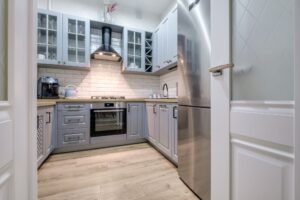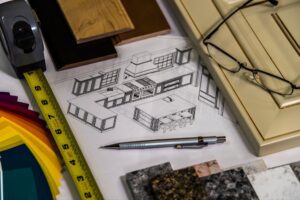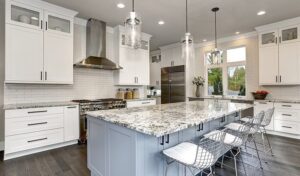
Semi-custom cabinets are pre-engineered designs you tailor with set options for size, finish, and hardware, which keeps them more affordable with a faster turnaround. Full-custom cabinets are built from scratch to any specification, offering total design freedom at a higher cost and longer timeline. The right choice depends on your budget, your layout, and how unusual your space is.
“Custom” sounds like the luxury option. Because of that, it’s often the choice people want to make, even though a semi-custom cabinet would look and work as well for less. It cuts the other way too: plenty of homeowners write off semi-custom cabinets, assuming they mean cookie-cutter, without realizing they are alterable.
If you’re remodeling and weighing the two, it’s worth knowing what sets them apart. Here’s a straight comparison of semi-custom and full-custom cabinets, along with guidance on deciding which one your project calls for.
Stock, semi-custom, and full-custom: three levels of cabinetry
Most cabinetry falls into four tiers. Let’s break down what three of those levels mean for your cabinets.
Stock cabinets are pre-built in fixed sizes and a limited set of finishes. They’re the most affordable and the fastest to get, but you’re working around what’s on the shelf. Sizes jump in set increments, and anything that doesn’t fit the grid gets covered with a blank filler panel.
Semi-custom cabinets are the middle tier. You start from established designs but tailor the size, finish, wood species, door style, and storage features to your space. You get most of the flexibility of a custom job at a price much closer to that of a stock job.
Full-custom, or bespoke, cabinets are the top tier, built entirely to your specifications with no preset menu. If you want customizable cabinets built to any specification, this is the top of the range.
What are semi-custom cabinets?
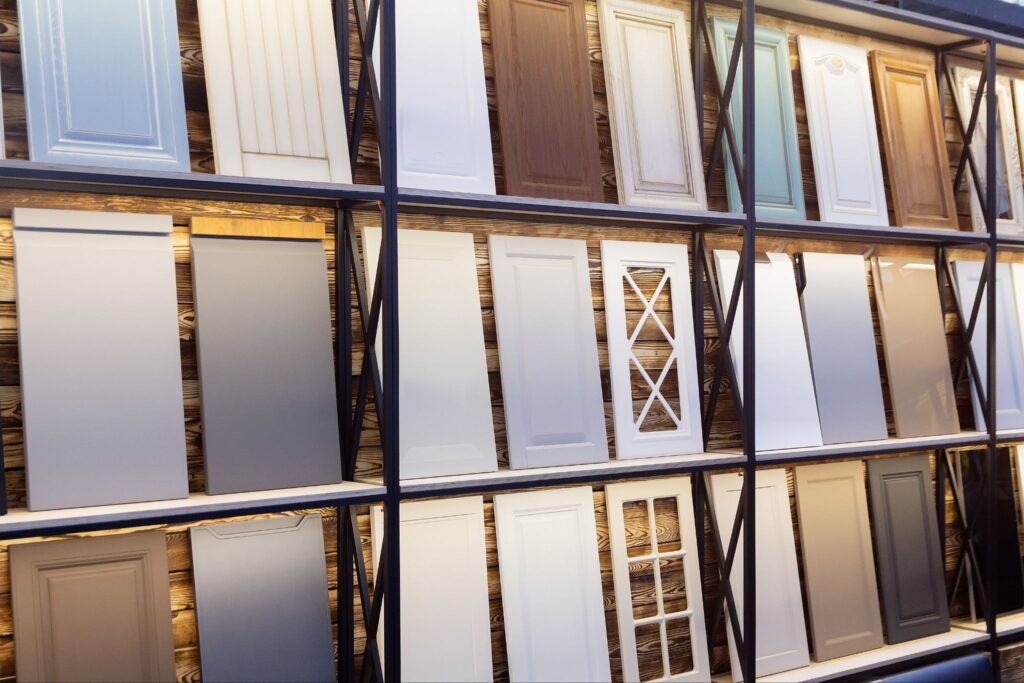
Semi-custom cabinets start with preset designs and door styles; you then tailor the details. You choose from a defined menu of sizes, finishes, wood species, door profiles, and hardware. Add upgrades like soft-close hinges, roll-out trays, or specialty inserts. Because the core designs are pre-engineered, they keep costs reasonable and timelines predictable while still letting you shape the room’s look and function.
You get customizable cabinets that you size to your walls, finish in your color, and fit to how you actually cook, all without paying for a fully one-off build.
What are full-custom (bespoke) cabinets?
You design bespoke cabinets to your own specifications, with no preset menu to work from. You decide every dimension, joint, material, and detail from the ground up. Want a 38-inch-tall drawer bank, an angled corner cabinet to match a sloped ceiling, or a one-of-a-kind island with a furniture-grade finish? Custom cabinets can.
Because the shop engineers and builds each piece individually, bespoke cabinets cost more and take longer to produce. They make the most sense when a space has unusual angles, you want a one-of-a-kind look, or when standard sizing won’t work.
Semi-custom vs. full-custom
| Feature | Semi-Custom Cabinets | Full-Custom (Bespoke) Cabinets |
| Design flexibility | High — choose within set options | Unlimited — built to any spec |
| Sizing | Standard sizes, with some adjustments | Any dimension you need |
| Lead time | Shorter and more predictable | Longer, due to one-off builds |
| Cost | More budget-friendly | Higher investment |
| Best for | Most standard kitchens and baths | Unusual layouts and unique designs |
Pros and cons of semi-custom cabinets
Here’s where semi-custom works well and where it falls short.
The upsides:
- Strong value since it has some of the flexibility of custom work at a lower price.
- Predictable, shorter lead times than a full bespoke build.
- A wide menu of sizes, finishes, door styles, and storage upgrades.
- Sized and finished to fit your room far better than stock cabinets.
The trade-offs:
- Sizing still works within set increments so that unusual dimensions may require filler panels.
- You’re choosing from a defined menu rather than designing from a blank page.
- Highly specialized features or one-of-a-kind shapes may be out of reach.
Pros and cons of full-custom cabinets
Customizable cabinets trade affordability and speed for total freedom.
The upsides:
- The ability to choose any size, shape, material, or detail is possible.
- Ideal for unusual layouts, odd angles, and non-standard ceiling heights.
- A finished look that’s specific to your home.
The trade-offs:
- The highest cost of the three tiers.
- They require longer lead times since every piece must be built individually.
- More design decisions to make, which may feel like a lot on a big project.
Does semi-custom mean lower quality?
This is one of the most common worries we hear, and the short answer is no, at least not when a skilled shop builds them well. “Semi-custom” describes how much you can change the design, not the quality of the build. The construction, materials, and finish are often as solid as a bespoke build.
A quality cabinetmaker builds semi-custom cabinetry with the same materials and craftsmanship as full-custom work. The difference is flexibility. For most homeowners, that means customizable cabinets that fit well and last, at a price that leaves room in the budget for the rest of the remodel.
Which type is right for you?
For most remodels, semi-custom cabinets offer the best balance of quality and value. If your kitchen or bathroom has a fairly standard footprint and you want customizable cabinets that look good and work hard without stretching your budget, semi-custom is usually the smart call.
Lean toward bespoke cabinets when your space has quirks, like odd angles, non-standard ceiling heights, or a tricky alcove, or when you have a specific vision that a semi-custom menu can’t quite capture. The simplest approach is to start with semi-custom and step up to full-custom only where your layout or design goals require it. Often, the best result is a mix of both.
When you’re weighing the two, a few practical factors usually settle it:
- Budget: Semi-custom stretches your dollar further; bespoke commands a premium.
- Timeline: If you’re working toward a deadline, semi-custom’s shorter lead time helps.
- Layout: Standard footprints suit semi-custom; quirky angles and odd dimensions favor full-custom.
- Design vision: A specific, unusual look may call for bespoke cabinets.
- How long you’ll stay: For a long-term home, investing in exactly what you want can pay off; for a shorter horizon, the value of semi-custom is hard to beat.
Cost variations
Cabinet pricing varies widely depending on materials, finishes, and room size, so treat any figure as an estimate rather than a quote. As a general guide, semi-custom typically lands in the middle of the range, above stock cabinetry but well below a full bespoke build. Custom work sits at the top because of the individual design and fabrication each piece requires.
One way to keep either option more affordable is to buy factory-direct rather than through a middleman, which removes a markup from the final price. For a solid number on your project, the best step is an in-person consultation, where someone measures the space and prices your actual layout instead of guessing from a brochure.
Frequently asked questions
Are semi-custom cabinets cheaper than bespoke cabinets?
Generally, yes. Because semi-custom cabinets are built from pre-engineered designs, they cost less and ship faster than bespoke cabinets, which get designed and then built one piece at a time.
Can customizable cabinets fit an unusual kitchen layout?
Often, yes. Semi-custom lines handle most layouts with adjustable sizing and filler pieces, while you build customizable cabinets to fit even the most unusual angles and dimensions exactly.
How long do custom cabinets take to make?
Semi-custom usually has a shorter, more predictable lead time, while bespoke cabinets take longer because each piece is made to order. Your timeline depends on the design, materials, and current production schedule.
Is semi-custom the same as stock cabinets?
No. Stock cabinets come in fixed sizes and finishes off the shelf, while semi-custom lets you tailor the size, finish, door style, and storage features. Semi-custom gives you far more control and a much better fit for your space.
Are full-custom cabinets worth the extra cost?
It depends on your space and goals. If you have an unusual layout or a specific design vision, bespoke cabinets will be worth it. For a standard kitchen or bath, semi-custom cabinets often deliver nearly the same result for less.
Can I mix semi-custom and full-custom cabinets in one kitchen?
Yes, and it’s often a smart approach. Many homeowners use semi-custom for the bulk of the room and add a few full-custom pieces where the layout or design calls for them, balancing cost and flexibility.
Get the cabinets you’ve been looking for with Mountain States Kitchen and Bath
Choosing between semi-custom and bespoke options comes down to your budget and how specific you need to get for your space. Either way, you want customizable cabinets that fit your home and how you live.
As a locally owned, Gephardt-Approved manufacturer, Mountain States Kitchen & Bath builds both semi-custom and full-custom cabinets. Because we’re the factory, that often means factory-direct pricing on either one, and we’ll help you weigh the trade-offs and decide which fits your space and budget.
Stop by our Lehi showroom at 1520 N State Street, call (801) 285-6769, or contact Mountain States here to schedule a free consultation. We’re here to make your remodel exciting.