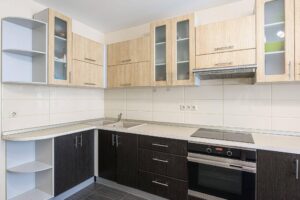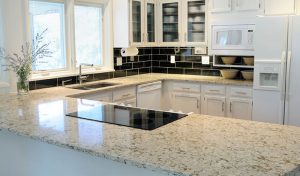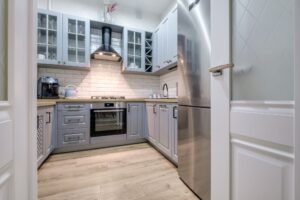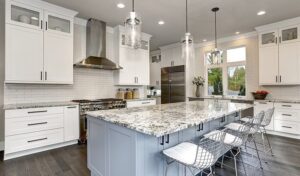
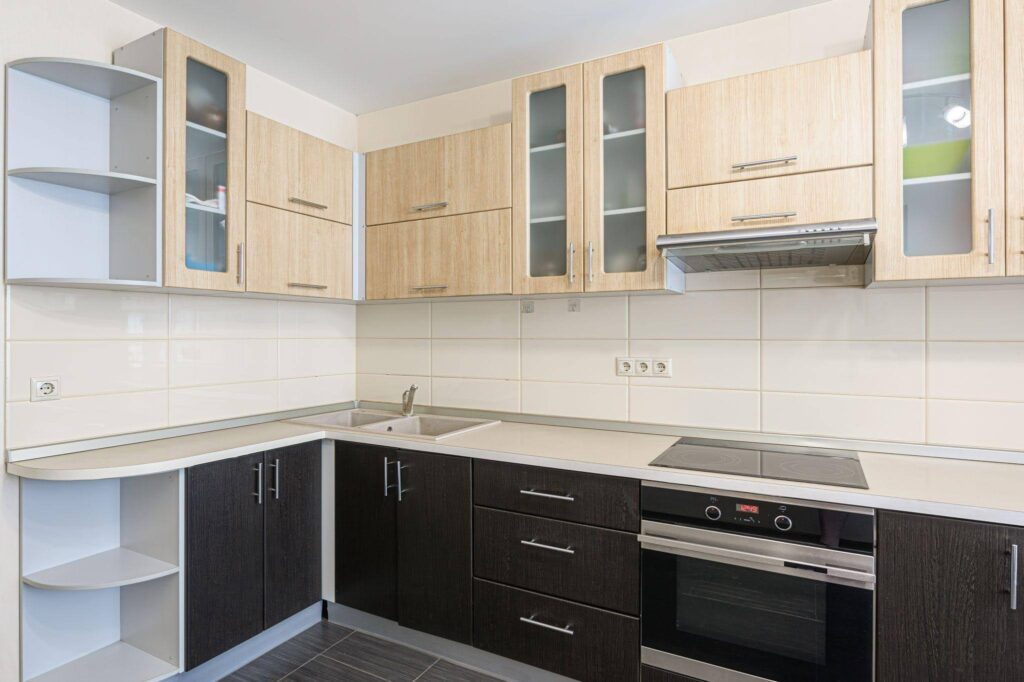
You’ve narrowed your cabinet choices to two colors, and you can’t pick one. Maybe it’s a warm white and a medium oak, or a soft cream and a deep green. Two-tone cabinets let you use both, and a well-planned pair of finishes can make a kitchen feel custom.
Getting the pairing right comes down to the details. Things like the undertone and sheen help your upper and lower cabinets read as one cohesive design.
This guide covers where each finish belongs, which pairings hold up over time, and how to coordinate paint with stain. If you haven’t settled on finish types yet, this breakdown of stained vs. painted cabinets compares durability and upkeep for each.
What are two-tone cabinets?
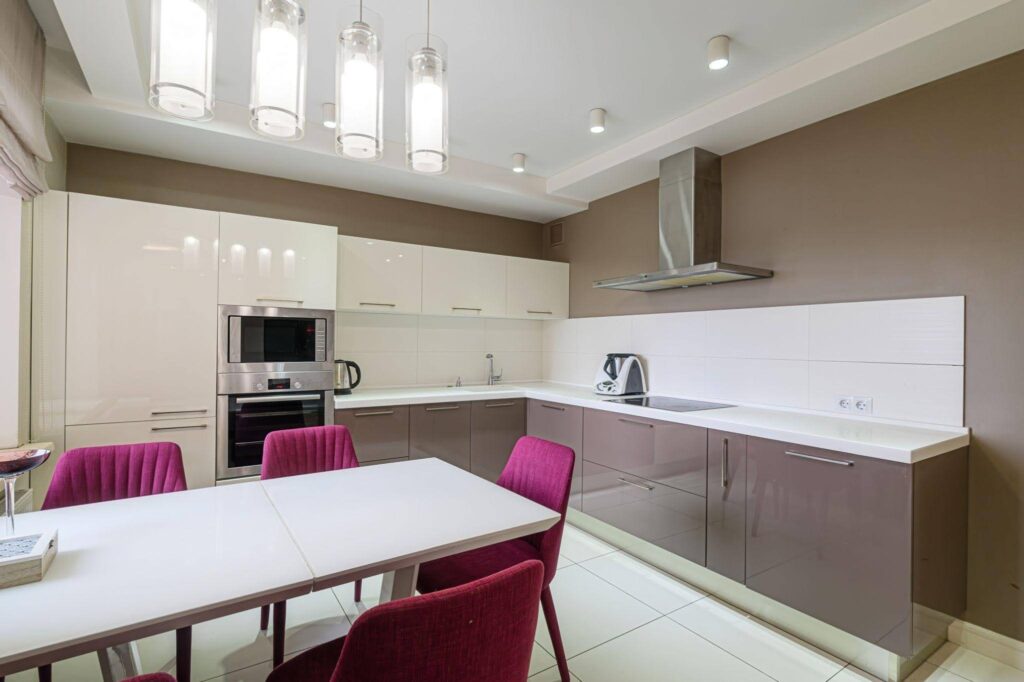
A two-tone kitchen uses two cabinet finishes in the same room. A finish is the surface treatment on a cabinet, such as paint, stain, or a clear natural coat, and it includes both the color and the sheen.
The split usually runs horizontally, with one color on the wall cabinets and another on the base cabinets. Some kitchens keep the perimeter in one finish and give the island its own color. Others pair a painted finish with a stained or natural wood finish.
The look has staying power.
The 2026 U.S. Houzz Kitchen Trends Study, which surveyed 1,780 renovating homeowners, found that 24% chose contrasting colors for their upper and lower cabinets. White led for contrasting uppers at 40%, followed by off-white at 19% and wood tones at 17%. For contrasting lowers, wood finishes took the top spot at 37%, followed by blue at 19% and green at 14%.
Those numbers show a clear pattern. Most homeowners who choose two-tone kitchen cabinets today pair a light painted upper with a wood or colored lower. The stark black-and-white split appears far less often, with black making up only 7% of contrasting lowers in the study.
Should upper cabinets be lighter than lower cabinets?
In most kitchens, yes. Designers put the lighter finish on top for three practical reasons:
- Wall cabinets sit at eye level and frame the room, so a light finish keeps the space feeling open and the ceiling feeling higher.
- Base cabinets take the most wear from shoes, vacuums, pets, and spills, and a darker color or visible wood grain hides scuffs better.
- A darker finish near the floor adds visual weight where the room can carry it, so the kitchen feels anchored instead of top-heavy.
Paint makers measure lightness with light reflectance value, or LRV. Sherwin-Williams prints each color’s LRV on the back of its paint chips and explains the scale, which runs from 0 (absorbs all light) to 100 (reflects all light). Comparing the LRV of your two choices shows how much contrast you’ll get before you commit. A wide gap creates a bold split, while a narrow gap reads as a subtle tonal shift.
Dark uppers over light lowers work, but the reverse layout suits a narrower set of kitchens. It performs best in large rooms with high ceilings and strong natural light, or in kitchens with only a few wall cabinets.
Two-tone cabinet color combinations that hold up
The pairings below follow the light-over-dark rule and use colors with compatible undertones.
| Upper cabinets | Lower cabinets |
| Warm white | Medium wood, such as white oak or maple |
| Off-white or cream | Sage or olive green |
| Bright white | Navy blue |
| Light gray | Charcoal |
| Light natural wood | Darker-stained wood, such as walnut |
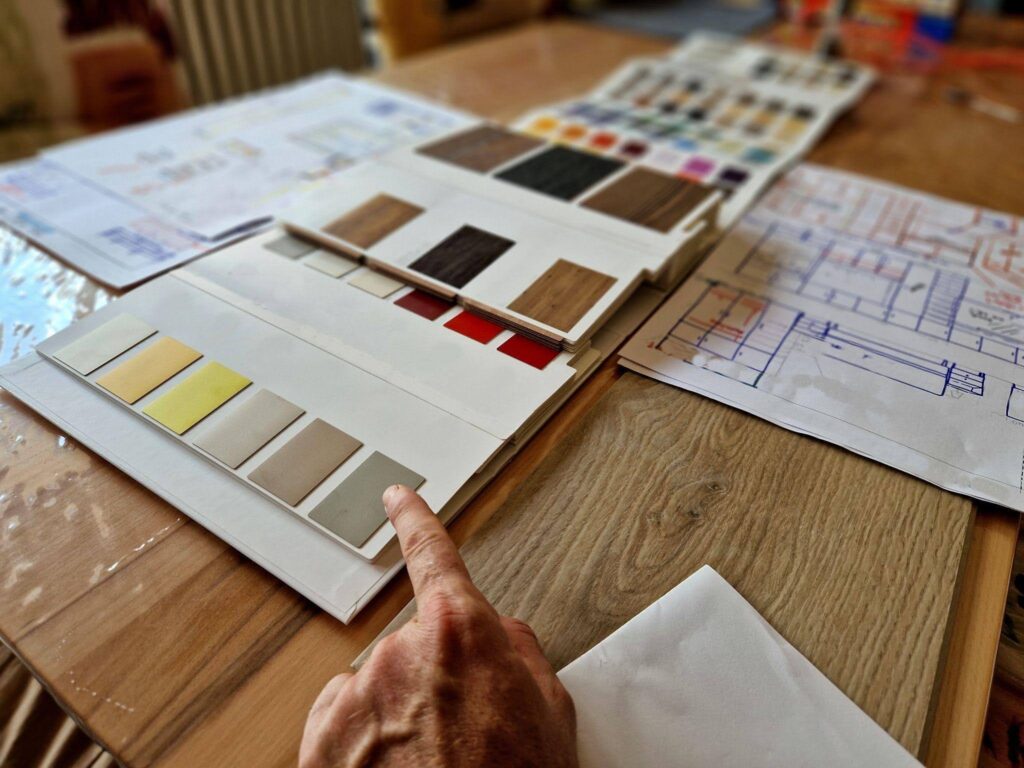
Before you order, test two-tone cabinet color combinations in the room where they’ll live. Set door samples side by side on the counter and check them in the morning, midday, and evening.
Kitchen light changes throughout the day, and a pairing that looks balanced under showroom lighting can shift at home. Hold both samples next to your countertop and flooring, too, since those surfaces sit between and beside the two cabinet finishes.
How to coordinate finishes on upper and lower cabinets
Color gets most of the attention, but the finish details determine how planned a two-tone kitchen looks.
Four checks keep the pairing cohesive.
Match the undertones
Every paint color and stain leans warm or cool. Warm whites carry yellow or red undertones and pair naturally with oak, cherry, and walnut. Cool whites lean blue or gray and sit better beside navy, charcoal, and gray-washed woods.
When the two sets share an undertone family, the contrast reads as deliberate even when the colors differ sharply.
Keep the sheen consistent
A satin-painted upper beside a high-gloss lower looks like two separate projects. Stained cabinets get a clear topcoat with its own sheen level, so ask your cabinet maker to match that topcoat to the paint sheen on the other set. Higher-sheen surfaces reflect more light, which also affects how bright each finish appears.
Use the same door style
Keep one door profile across the whole kitchen so the color change is the only difference between the two sets. Shaker doors suit the look because their simple frame shows both paint and stain well.
Choose one hardware finish
A single hardware finish ties the two colors together. Brass and gold tend to warm up greens and woods, while nickel and black suit cooler palettes.
A common two-tone approach pairs painted upper cabinets with stained wood lowers. A cabinet maker who builds custom kitchen cabinetry can often finish both sets in the same production run, which makes undertone and sheen easier to control.
Finish options also vary by cabinet line, and the guide to semi-custom vs. full-custom cabinets explains how many choices each tier offers.
The countertop sits right where the two finishes meet, so it works as the bridge between them. A veined stone that hints at both cabinet colors visually connects the uppers and lowers. The comparison of quartz vs. granite countertops helps you weigh patterns and durability.
Other ways to plan two-tone kitchen cabinets
A horizontal split between uppers and lowers is the most common layout, but two other approaches give you more control over the amount of contrast.
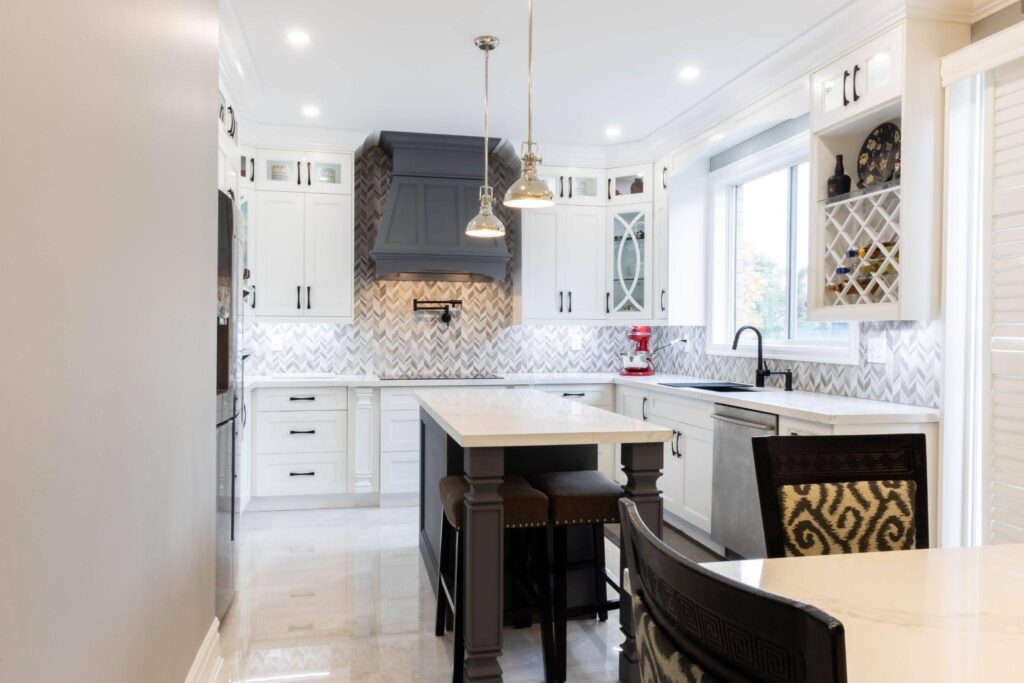
An island in a contrasting color offers the lowest-commitment version of the look. The perimeter stays in one finish, and the island becomes the focal point. This layout works well if you plan to update colors later, since repainting or refacing one island costs less than redoing a full wall of cabinets.
Tall cabinets need a plan of their own. Pantry cabinets and refrigerator surrounds run from floor to ceiling, so they don’t fit neatly into an upper or lower group. Many designers finish them to match the base cabinets because they touch the floor, or group them with the uppers when they sit on the same wall as the wall cabinets.
Smaller kitchens benefit from lower contrast. A light upper with a mid-tone lower keeps a compact room from feeling divided, and these small kitchen ideas cover layout and storage strategies that complement the approach.
Frequently asked questions
Are two-tone cabinets still in style?
Yes. The 2026 Houzz study found that nearly a quarter of renovating homeowners chose contrasting colors for their wall and base cabinets. The look has shifted toward softer pairings, such as white over wood or off-white over green, rather than stark black-and-white.
What are the most popular two-tone cabinet color combinations?
White or off-white uppers over wood lowers lead current choices, followed by white over blue and cream over green. These pairings keep the upper half of the room bright while the lower half adds warmth or color.
Can you mix wood and painted cabinets in the same kitchen?
Yes, and it ranks among the most common two-tone approaches. Match the paint’s undertone to the wood tone and keep the door style consistent.
Should the island be a different color than the rest of the cabinets?
It can be, and a contrasting island is the simplest way to try two tones. Choose an island color that relates to something else in the room, such as the flooring, the hardware, or a vein in the countertop.
Do two-tone cabinets cost more than a single finish?
It depends on the manufacturer. Some companies price each finish separately, and specialty paints or stains add cost. Ask your cabinet maker to quote both a single-finish layout and a two-tone layout so you can compare.
What countertop color works with two-tone kitchen cabinets?
White and off-white countertops pair well with most cabinet colors because they don’t compete with either. A veined pattern that picks up both cabinet colors connects the two finishes.
Plan your two-tone kitchen with Mountain States Kitchen and Bath
A successful two-tone kitchen comes down to placement, undertone, and consistency. Put the lighter finish up high, match the undertones and sheen, and let the countertop and hardware tie the two colors together.
Mountain States Kitchen and Bath builds custom cabinetry factory-direct, so you work with the people who make your cabinets from design through installation. That direct line makes it easier to fine-tune two-tone cabinets, from choosing the split to matching topcoat sheen across paint and stain. The company is Gephardt Approved and serves homeowners from Lehi to Payson.
Visit the showroom at 1520 N State Street in Lehi, Monday through Friday from 9 a.m. to 5 p.m., to see door styles and finishes in person. You can also call 801-285-6769 or contact Mountain States online to start planning your kitchen.